
GUT & MICROBIOME
The Gut-Brain Axis: Microbiome and Mental Health
Medically reviewed by Fawad Ahmed, MD on
Published · Updated
The connection between the gut and the brain, known as the gut-brain axis, has drawn a lot of research interest, and scientists are studying how gut microbes may affect mood, memory and hormones.
Book a Consultation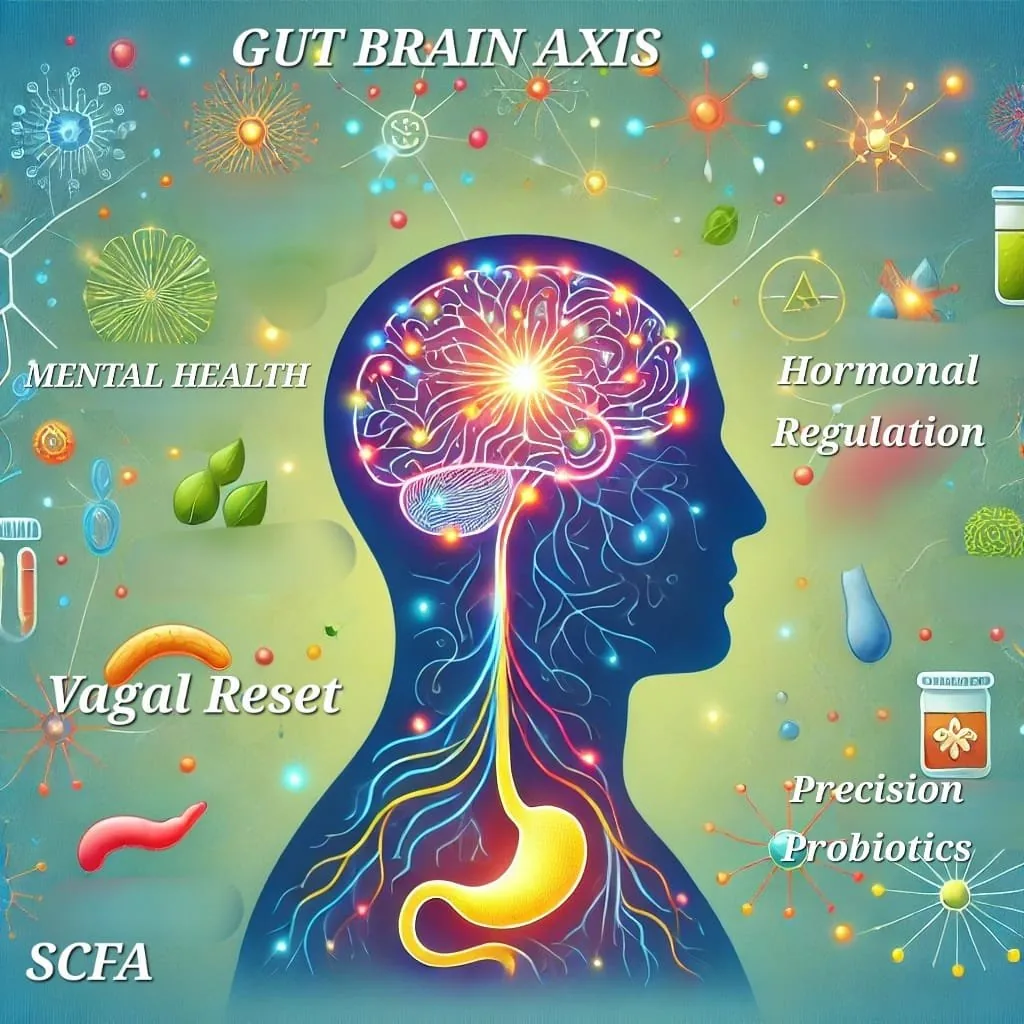
How the gut and brain communicate
The connection between the digestive tract and the brain, known as the gut-brain axis, has drawn significant research interest in recent years. Research suggests that the gut microbiome—the diverse community of microorganisms living in our intestines—may influence brain function and mental health, although much of the evidence so far comes from studies in animals.
The gut-brain axis encompasses two-way communication pathways linking the gut and the brain, involving nerves, hormones and the immune system. Studies, mostly in animals, show that gut microbes can affect brain chemistry and body systems involved in stress, anxiety and memory. In turn, the brain influences how the gut works, such as how food moves through it (motility) and the acid and mucus it releases, and it may also affect which microbes live there.
Did You Know?
The gut is home to trillions of microorganisms. Researchers estimate that an adult body has about 38 trillion bacteria and about 30 trillion human cells, so the two numbers are roughly the same. Together, these bacteria weigh about 0.2 kg (under half a pound). In one study of 124 European adults, the group as a whole carried about 1,000 to 1,150 common species of gut bacteria, and each person carried at least 160.
The gut microbiome and mental health
Studies have found links between gut bacteria and mental health, and researchers are testing whether changing gut bacteria could help:
Psychobiotics
"Psychobiotics" is a name for probiotics (live microbes meant to have health benefits) and prebiotics (food parts we can't digest that feed certain helpful microbes) when they are studied for effects on mental health. Gut bacteria can make chemical messengers, such as GABA and serotonin, that act on the gut's own nervous system. In a study in mice, a probiotic strain changed the activity of GABA-related genes in the brain and reduced anxiety- and depression-related behavior. A 2024 review of 51 clinical trials found the clearest results for symptoms of depression. But the trials used different products and included different kinds of patients, which makes the results hard to compare or apply widely. Some of the trials found no difference between the probiotic and a placebo (a dummy treatment).
Short-chain fatty acids
When gut bacteria break down fiber, they make short-chain fatty acids (SCFAs), such as acetate, propionate and butyrate. Scientists think SCFAs may play a key role in signaling between the gut, the immune system, hormones and the brain, but how they affect the brain is not yet fully understood. Some studies have found lower SCFA levels in the stool of people with depression, and in rats, butyrate reversed depression-like behavior. Much of this research has been done in animals.
Where the research is going
Personalized nutrition and microbiome modulation
Researchers are interested in using information about a person's gut microbiome in medical care, for example to predict how someone will respond to a treatment. So far, this is rarely used in everyday care:
Microbiome sequencing
Labs can read the genetic material of the bacteria in a stool sample, which is called sequencing. An international panel of experts found there is not yet enough evidence to recommend routine microbiome testing in medical care.
Precision probiotics
Researchers are testing specific probiotic strains for mental health and memory. In the 2024 review of clinical trials, some studies found better memory, thinking or sleep in people who took a probiotic, while others found no difference from a placebo. Different probiotics may have different effects, so results for one strain may not apply to another.
Emerging Technology
Stool tests that list the bacteria in a sample are already sold, including directly to consumers. When scientists at NIST, a U.S. government agency, sent identical stool samples to seven test companies, the results were quite different. An international expert panel also says there is no agreed definition of an "unhealthy" or "imbalanced" gut microbiome (dysbiosis), and it strongly discouraged test providers from giving treatment advice based on the results.
Microbiota transplants for neurological disorders
Researchers are also studying whether moving gut microbes from one person to another could help with brain and nerve conditions:
Fecal microbiota transplantation (FMT)
Fecal microbiota transplantation (FMT) means putting stool from a donor into another person's intestines. It is being studied for neurological conditions such as Parkinson's disease, Alzheimer's disease and autism. A 2020 review found that only a small number of studies had been done in people, that some conditions had been studied only in animals, and that the evidence was still scanty.
Alzheimer's disease research
A 2020 review found that FMT for Alzheimer's disease had been tested only in animal models, such as mice. These animal studies suggested a possible benefit, but whether such results will hold true in people is not yet known.
Note: For brain and nerve conditions, FMT is still being studied, and large, well-designed trials are needed. In the U.S., the FDA has approved fecal microbiota products to help prevent C. difficile infection (a gut infection that causes diarrhea) from coming back in adults. FMT should only be done under medical supervision, such as in a clinical trial.
Polyphenols and postbiotics
Beyond probiotics, researchers are studying other compounds that may play a part in the gut-brain relationship:
- Polyphenols — Polyphenols are plant compounds found in foods and drinks such as berries, cocoa, tea and spices. Most of them are not absorbed in the small intestine and travel to the colon, where gut bacteria break them down. Polyphenols can change the mix of gut bacteria, and researchers are studying whether this affects memory and thinking. Much of this evidence comes from animal studies, and many human trials have been small and short.
- Postbiotics — An international expert panel defines postbiotics as preparations of non-living microbes or their parts that give a health benefit. Under this definition, purified substances made by bacteria, such as butyrate, are not postbiotics. Short-chain fatty acids made by gut bacteria can cross the blood-brain barrier (the brain's protective lining), but how they act on the brain is still largely unknown.
Polyphenol-rich foods
- Berries
- Cocoa
- Green Tea
- Turmeric
The microbiome and hormones
Gut bacteria also interact with the body's hormones, including estrogen:
Hormonal Regulation
Scientists use the word "estrobolome" for the set of gut bacteria genes whose products can process (metabolize) estrogen. The amounts of certain bacterial enzymes in the gut affect how much estrogen circulates in the body. A direct link between this process and metabolic changes in pregnancy or menopause has not yet been shown.
What studies have found
Small studies have found differences in gut bacteria in women with premenstrual symptoms and in women with depression after childbirth (postpartum depression). Menopause also comes with changes in gut bacteria. These studies show links, not cause and effect, and the role of the gut microbiome in women's health is still largely unknown.
What you can do
Scientists are still working out how gut bacteria and the brain affect each other. Here is what research says about some everyday steps:
Eat a diverse, fiber-rich diet
Fruits, vegetables, whole grains and beans contain fiber, which gut bacteria break down into short-chain fatty acids. In a large citizen-science study, eating more kinds of plants was linked to a more varied mix of gut bacteria. People who ate more than 30 kinds of plants a week had more of some bacteria thought to ferment fiber than people who ate fewer than 10.
Include fermented foods
Yogurt, kefir, kimchi and sauerkraut are fermented foods. In a 17-week study, healthy adults who ate many more fermented foods ended up with a more varied mix of gut bacteria and lower levels of some markers of inflammation. The study was small (18 people in this group), so the results may not apply to everyone.
Limit ultra-processed foods
Ultra-processed foods are ready-to-eat products that are often high in calories. Some contain emulsifiers, additives that changed gut bacteria in mice and in a small study in people. In a large study of U.S. women, those who ate the most ultra-processed food were more likely to develop depression, but how the two are linked is not known.
Consider probiotics with caution
Probiotics sold as dietary supplements don't need FDA approval before they are sold, and different types may have different effects. For most uses, researchers still don't know which probiotics help. If you're thinking about a probiotic supplement, talk with your health care provider first.
Much of the research on the gut-brain axis so far has been done in animals, and whether those findings hold true in people is still being studied. For more on fiber and fermented foods, see our article on foods and gut health.
Start your gut-brain health journey with Avicenna Functional Medicine today.
Further reading
For more on this topic from independent sources:
- Carabotti M, et al. “The gut-brain axis: interactions between enteric microbiota, central and enteric nervous systems.” Annals of Gastroenterology, 2015. https://pmc.ncbi.nlm.nih.gov/articles/PMC4367209/
- Mosquera FEC, et al. “Effectiveness of Psychobiotics in the Treatment of Psychiatric and Cognitive Disorders: A Systematic Review of Randomized Clinical Trials.” Nutrients, 2024. https://pmc.ncbi.nlm.nih.gov/articles/PMC11085935/
- Silva YP, Bernardi A, Frozza RL. “The Role of Short-Chain Fatty Acids From Gut Microbiota in Gut-Brain Communication.” Frontiers in Endocrinology, 2020. https://pmc.ncbi.nlm.nih.gov/articles/PMC7005631/
- Vendrik KEW, et al. “Fecal Microbiota Transplantation in Neurological Disorders.” Frontiers in Cellular and Infection Microbiology, 2020. https://pmc.ncbi.nlm.nih.gov/articles/PMC7105733/
- Porcari S, et al. “International consensus statement on microbiome testing in clinical practice.” The Lancet Gastroenterology & Hepatology, 2025. https://doi.org/10.1016/S2468-1253(24)00311-X
- National Center for Complementary and Integrative Health (NCCIH). “Probiotics: Usefulness and Safety.” https://www.nccih.nih.gov/health/probiotics-usefulness-and-safety
If you’re interested in taking a proactive approach to your health, book a 30-minute discovery call.
Book a Discovery Call