GUT & MICROBIOME
The 5R Approach to Gut Health: A Functional Medicine Guide
Medically reviewed by Fawad Ahmed, MD on
Published · Updated
The 5R framework is a functional medicine approach that groups gut care into five steps. Here is what each step involves, and what research does and doesn't show so far.
Book a Consultation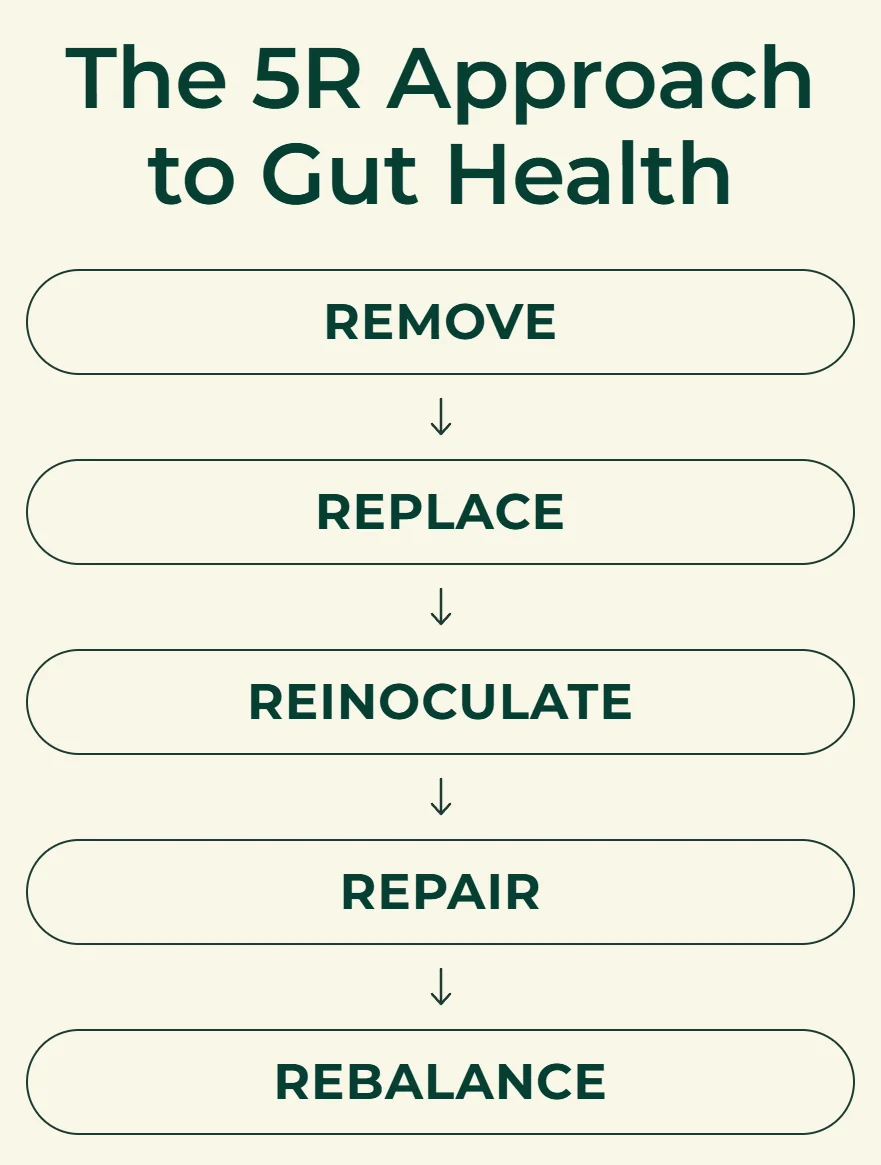
At Avicenna Functional Medicine, we look for the factors that may be behind your gut symptoms, sometimes called the root cause. The 5R framework is a program used in functional medicine to organize this work. Its five steps are remove, replace (also called replenish), reinoculate, repair and rebalance.
Some of the popular advice behind these steps is not yet proven. A 2019 review in the medical journal Gut looked at popular advice for a "leaky gut." It said advice to cut out foods, eat fermented foods or take supplements "to repair the damage" needs to be confirmed before experts can recommend it. Here is what each step involves, and what research does and doesn't show so far:
The five steps
1. Remove
The first step is to look for things that may cause or add to gut symptoms. For people with celiac disease, eating gluten, a protein in wheat, barley and rye, damages the small intestine. People with lactose intolerance may have symptoms within a few hours after having milk or other foods that contain lactose, the natural sugar in milk.
Gut infections are another possible cause. Most food poisoning, for example, is caused by germs such as viruses, bacteria and parasites. Another possible cause is SIBO (small intestinal bacterial overgrowth), when very large numbers of bacteria grow in the small intestine. Candida infection (candidiasis) is known to cause gut symptoms, mainly in people with weak immune systems or who take steroids or antibiotics. Researchers are also looking at whether fungal overgrowth in the small intestine (SIFO) may cause unexplained gut symptoms in other people. More studies are needed to confirm this and to learn what it means for health.
If you think gluten bothers you, talk with your doctor before cutting it out: doctors don't recommend starting a gluten-free diet before testing for celiac disease, because the diet can affect the test results. Experts also advise trying to confirm SIBO with a test before treating it with antibiotics.
At Avicenna Functional Medicine, testing is chosen for you, and you get a personalized plan. Your plan may include changes to what you eat. For example, for irritable bowel syndrome (IBS), a doctor may suggest trying the low FODMAP diet for a few weeks. This diet cuts down on certain carbohydrates that are hard to digest. If symptoms improve, foods with FODMAPs are slowly added back.
2. Replace
The second step looks at whether your body makes enough of what it needs to digest food. Your body uses digestive juices, such as stomach acid, bile and enzymes, to break food into smaller parts. In some conditions, the body makes too little of a digestive enzyme. In lactose intolerance, for example, the small intestine makes low levels of lactase, the enzyme that breaks down lactose. Chronic pancreatitis is a long-lasting inflammation of the pancreas. It can make it hard to digest food properly. In that case, a doctor may give enzyme pills to help with digestion.
If testing points to a problem like this, your clinician will talk with you about the options. Talk to your clinician before starting any supplement, including digestive enzymes. Supplements may interact with your medicines or pose risks if you have certain medical problems or are going to have surgery.
3. Reinoculate
Your microbiome is the collection of microbes, such as bacteria, fungi and viruses, that live on and inside your body. Your gut has its own community of these microbes. This community can change over time with diet, medicines and things in your environment. Antibiotics, for example, can change your gut bacteria. But experts have not agreed on what an "imbalanced" gut microbiome is. An international expert panel noted that a common definition of dysbiosis (an imbalanced microbiome) is not available.
This step uses probiotics and prebiotics. Probiotics are live microbes meant to have health benefits when you take them. Prebiotics are parts of food that your body can't digest and that boost the growth of good microbes.
A great deal of research has been done on probiotics, but much remains to be learned about whether they are helpful and safe for various health conditions. In 2020, the American Gastroenterological Association (AGA) found that for most digestive conditions, there is not enough evidence to support using probiotics. This includes Crohn's disease, ulcerative colitis and IBS. The AGA did support certain probiotics in a few settings, such as helping prevent C. difficile infection in people taking antibiotics. C. difficile is a germ that can infect the colon after antibiotics and cause diarrhea. Talk to your clinician before starting a probiotic. The risk of harm from probiotics is greater in people with severe illnesses or weak immune systems.
Some people ask about stool tests that map the gut microbiome. A 2025 international expert consensus found there is not yet enough evidence to recommend routine microbiome testing in medical care. The experts strongly discouraged test reports that give treatment advice. They said treatment decisions are complex and can't rely on a single test. They also called for studies that compare choosing probiotics from test results with a standard, one-size-fits-all approach. If microbiome testing is part of your plan, the result is one piece of the picture, not a diagnosis.
4. Repair
This step focuses on the gut lining, which works as a barrier. The barrier includes a layer of mucus, a layer of cells, and immune defenses. Diseases that inflame or damage the gut, such as celiac disease and Crohn's disease, make this barrier leakier. "Leaky gut" is a simple term for intestinal permeability, or how much the gut lining lets through.
But "leaky gut syndrome" is not an accepted medical diagnosis. No validated test exists to diagnose it. Research has linked gut barrier problems to a limited number of conditions, including IBS, inflammatory bowel disease and type 1 diabetes. Type 1 diabetes is an autoimmune disease, in which the immune system attacks the pancreas. Leaky gut has also been linked to other diseases, including the autoimmune disease rheumatoid arthritis, but based on limited or no supporting data.
Some data link food allergies to a leakier gut, but reactions to food likely have many causes. Many symptoms are blamed on a leaky gut, such as bloating, belly pain, tiredness and headache. But there is currently no evidence that these symptoms are directly linked to a leaky gut. It is also still unproven that improving the gut barrier eases symptoms of gut diseases or diseases that affect the whole body.
Some nutrients have been studied for their effect on gut permeability, including vitamins A and D, zinc and glutamine. Of these, glutamine may have the most data so far, but the data are still limited. Experts say more data are needed before any of these supplements, including glutamine, can be recommended in medical care. Talk to your clinician before starting any supplement. "Natural" does not always mean "safe."
5. Rebalance
Nerves and hormones help control digestion, and signals flow back and forth between your gut and your brain. Doctors now call IBS a disorder of gut-brain interaction, which means it is related to problems with how the brain and gut work together. For IBS, research suggests that some lifestyle changes may help symptoms: more physical activity, reducing stressful life situations as much as possible, and getting enough sleep. Doctors may also recommend mental health therapies for IBS, such as cognitive behavioral therapy, gut-directed hypnotherapy and relaxation training.
In a functional medicine visit, we may also look at stress, sleep and physical activity as part of your personalized plan.
At Avicenna Functional Medicine, all visits are by telehealth for patients located in Florida and Texas. Testing is chosen for you, and you get a personalized plan with follow-up visits. Our care does not replace your gastroenterologist or primary care doctor, or the treatment they prescribe. Please do not stop or change any prescribed medication without talking to the doctor who prescribed it.
Further reading
For more on this topic from independent sources:
- National Institute of Diabetes and Digestive and Kidney Diseases (NIDDK). “Your Digestive System & How it Works.” https://www.niddk.nih.gov/health-information/digestive-diseases/digestive-system-how-it-works
- National Center for Complementary and Integrative Health (NCCIH). “Probiotics: Usefulness and Safety.” https://www.nccih.nih.gov/health/probiotics-usefulness-and-safety
- Camilleri, M. 2019. “Leaky gut: mechanisms, measurement and clinical implications in humans.” Gut 68 (8): 1516–1526. https://pmc.ncbi.nlm.nih.gov/articles/PMC6790068/
- Lacy, B. E., J. L. Wise, and D. J. Cangemi. 2024. “Leaky Gut Syndrome: Myths and Management.” Gastroenterology & Hepatology. https://pmc.ncbi.nlm.nih.gov/articles/PMC11345991/
- Porcari, S., et al. 2025. “International consensus statement on microbiome testing in clinical practice.” The Lancet Gastroenterology & Hepatology 10: 154–167. https://doi.org/10.1016/S2468-1253(24)00311-X
- American Gastroenterological Association (AGA). 2020. “AGA does not recommend the use of probiotics for most digestive conditions.” https://gastro.org/press-releases/aga-does-not-recommend-the-use-of-probiotics-for-most-digestive-conditions/
If you’re interested in taking a proactive approach to your health, book a 30-minute discovery call.
Book a Discovery Call