GUT & MICROBIOME
Inflammatory Bowel Disease and Environmental Toxins
Medically reviewed by Fawad Ahmed, MD on
Published · Updated
Inflammatory bowel diseases — ulcerative colitis, Crohn's, and microscopic colitis — share one common thread: increased permeability of the gut lining, also known as leaky gut.
Book a Consultation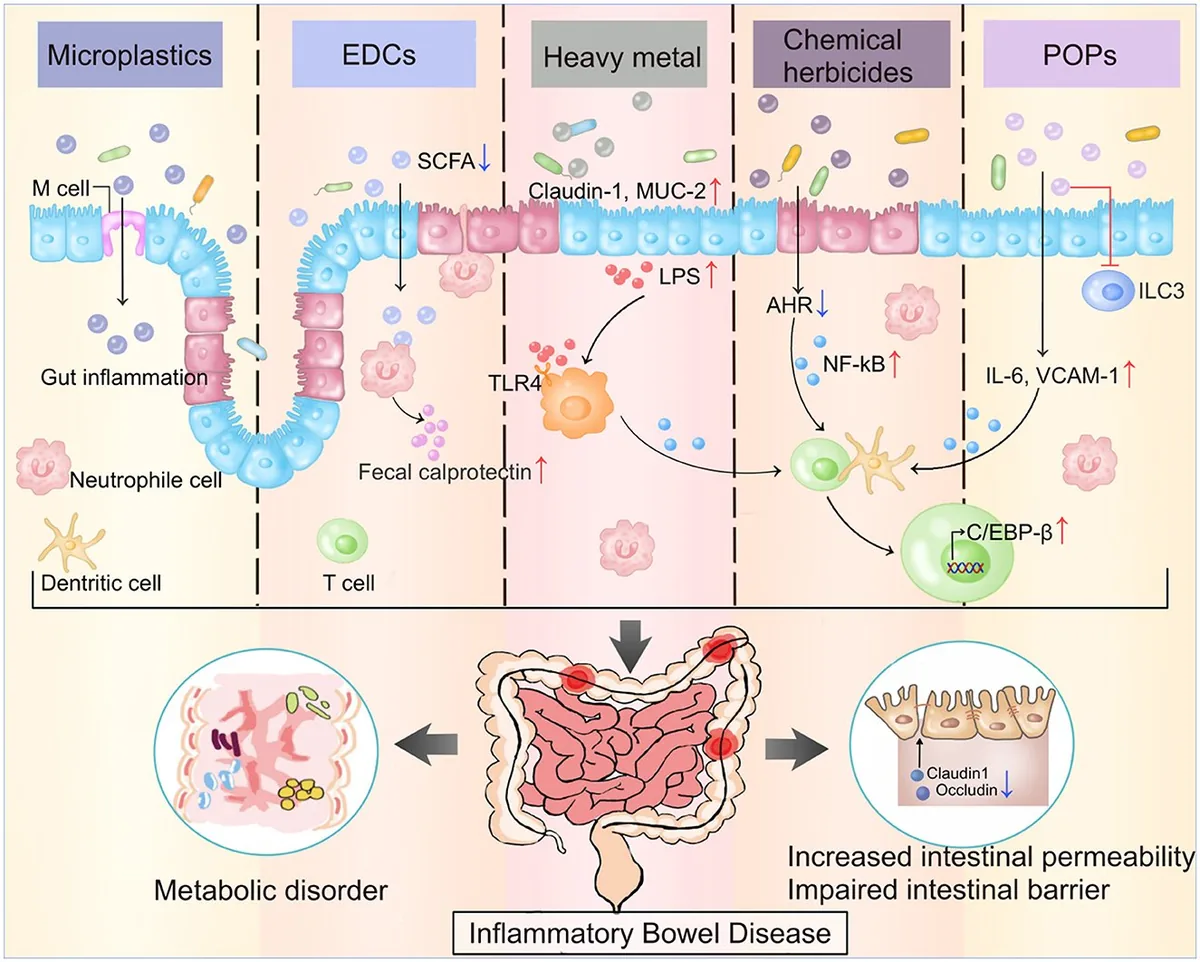
Inflammatory bowel diseases (IBD), including ulcerative colitis, Crohn's, and microscopic colitis, all have one thing in common: increased permeability of the gut lining, also known as "leaky gut." These diseases can be aggressive and often need strong medications to control them. Our approach is to minimize the use of drugs by improving gut health in multiple ways. Do not stop any IBD medication without discussing it with your GI specialist first.
Five steps to discuss with your gastroenterologist
1. Reduce environmental toxin exposure
Reduce exposure to environmental toxins such as parabens, phthalates, BPA, microplastics, heavy metals, herbicides, and pesticides. These have all been associated with a higher risk of IBD. Ask your clinician whether heavy metal testing makes sense for you.
2. An anti-inflammatory diet
Eat an anti-inflammatory diet: one that is organic, whole food, high fiber, gluten-free, and avoids junk and processed foods.
3. Microbiome and gut testing
Testing can give us information about possible food sensitivities and which supplements may help you the most. It is not covered by insurance. Some supplements have been shown to help put IBD into remission. Don't forget to work on reducing stress, avoiding NSAIDs and PPI medications where possible, avoiding alcohol and smoking, and improving sleep and exercise. These are key factors in addressing poor gut health and leaky gut.
4. Probiotics and prebiotics
For mild-to-moderate microscopic colitis (MC), trials have shown impressive benefits from certain multi-strain probiotics.
VSL#3 research findings
- VSL#3 induces and maintains short-term clinical response in patients with active microscopic colitis, used at 900 billion CFU daily for microscopic colitis with or without mesalamine.
- A randomized trial found VSL#3 superior to mesalamine at week 10 in inducing clinical response for active microscopic colitis.
- VSL#3 induced remission in patients with mild-to-moderately active ulcerative colitis at a rate of 43% versus 15% for placebo, with those already on mesalamine staying on it.
5. Considerations for Crohn's disease
For Crohn's disease (CD), there is some evidence of benefit for Bifidobacterium longum (strain BB536) combined with an inulin/FOS prebiotic. Another promising probiotic awaiting more research is Akkermansia muciniphila, a bacteria that helps maintain the gut lining. There is also good evidence that a temporary elemental diet for 14 days can treat CD flares just as effectively as steroids.
Please note: Do not stop any current medications without talking to your physician first.
In summary
An integrative medicine approach — reducing toxin exposure, changing diet, microbiome testing, and a course of precision probiotics — may be helpful in working toward remission of IBD conditions. Contact us for an evaluation if you are suffering from IBD.
References
- Reduce exposure to environmental toxins such as parabens, phthalates, BPA, microplastics, heavy metals, herbicides, and pesticides. These all have been associated with higher risk of IBD (Visit: https://www.frontiersin.org/journals/public-health/articles/10.3389/fpubh.2023.1140786/full for evidence). Ask your clinician whether heavy metal testing makes sense for you.
- a) https://pmc.ncbi.nlm.nih.gov/articles/PMC4599154/
- b) https://academic.oup.com/ibdjournal/article-abstract/14/suppl_3/S24/4654645
- c) https://www.cghjournal.org/article/S1542-3565(09)00672-7/fulltext
- a) Here is a link to the clinical trial comparing elemental diet to steroids for CD flares https://pubmed.ncbi.nlm.nih.gov/9305483/
- b) Here is a link to the research showing benefit for Crohn's using Bifidobacterium longum (strain BB536) with Inulin/FOS prebiotic: https://www.frontiersin.org/journals/medicine/articles/10.3389/fmed.2022.887044/full
If you’re interested in taking a proactive approach to your health, book a 30-minute discovery call.
Book a Discovery Call